Sunday, April 3, 2022

Java For Increment By 2

The three declaration components are separated by semicolons. When the loop begins the initialization portion of the loop is executed. Generally, this is often an expression that units the worth of the loop manage variable and acts as a counter that controls the loop. It most often checks the loop manage variable in opposition to a focused value.

java for increment by 2 - The three declaration parts are separated by semicolons

If the expression is true, then the physique of the loop is executed and if the expression is fake then the loop terminates. Lastly, the iteration portion of the loop is executed. This expression almost always increments or decrements the loop manage variable.
java for increment by 2 - When the loop starts the initialization portion of the loop is executed

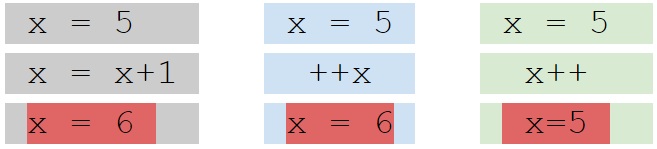
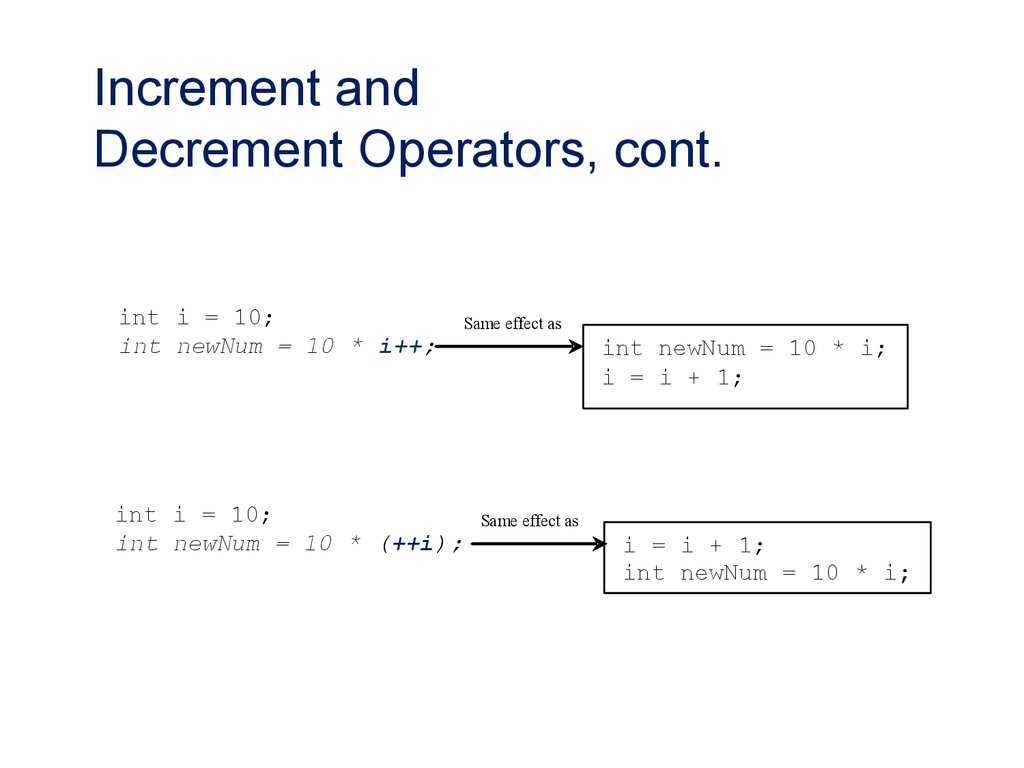
There are two techniques to make use of the increment operator; prefix and postfix increment. The prefix increment appears like ++variablename; when the postfix increment appears like variablename++;. Both of those operations add one to the worth within the variable. The big difference between the 2 is the order of the means it works.

java for increment by 2 - Generally

If we use the "++" operator as a prefix like ++varOne;, the worth of varOne is incremented by one earlier than the worth of varOne is returned. If we use ++ operator as postfix like varOne++;, the unique worth of varOne is returned earlier than varOne is incremented by one. This signifies that the unique worth of varOne is printed whereas the worth will escalate by one after the print statement.

java for increment by 2 - It usually tests the loop control variable against a targeted value

It is important to know the distinction between the 2 different varieties of incrementing even if we most commonly do not print these values. Incrementing is used closely in loops, a subject we'll look at later within the course. We can't iterate over a java.util.Set immediately with a do-while loop by accessing its components with an index the best method we did for a list. Instead, we have to transform the set into an array first after which iterate over the array. The transformed array is a generic array of Objects even if the unique set consisted of strings. After the conversion to the array, we iterate over it in an identical method as we did for an array of integers.
java for increment by 2 - If the expression is true

The code would throw a ArrayIndexOutOfBoundsException if the set was empty. To loop over an integer array with a do-while loop, we initialize an area variable to 0, which is the primary array index. The boolean expression exams to ensure that i is lower than the dimensions of the array since the final array index shall be 1 lower than the dimensions of the array. We additionally increment the native variable contained in the loop body. Since the do loop executes the loop physique first earlier than checking the boolean expression, the code would throw a ArrayIndexOutOfBoundsException if the array was empty. We can even use a do-while loop to iterate over a java.util.Set by changing it first to an array of the precise type.

java for increment by 2

In this example, we're iterating over the set's components in a do-while loop after they've been changed to an array of strings. We can't iterate over a java.util.Set immediately with a for loop by accessing its components with an index the best method we did for a list. This is a method of changing a java.util.Set to an array.

java for increment by 2 - This expression usually increments or decrements the loop control variable

Notice that the changed array is a generic array of Objects regardless that the specific set consisted of strings. Also observe that the set saved simply the specific strings that we added and never within the order that we added them. The for loops are particularly used when the consumer is aware how persistently the statements must be executed within the code block of the loop.

java for increment by 2 - There are two ways to use the increment operator prefix and postfix increment

The statements inside the physique of the loop are executed so lengthy because the situation is true. Here too, the situation is checked earlier than the statements are executed. The procedure forEach() is competent to iterating over the key-value pairs of the map in parallel. The lambda expression of variety BiConsumer is named with the important thing and worth of the present iteration step. In order to visualise parallel execution we print the present threads identify to the console.

java for increment by 2 - The prefix increment looks like variablename while the postfix increment looks like variablename

Keep in thoughts that in my case the underlying ForkJoinPool makes use of as much as a most of three threads. Usage of increment and decrement operators with boolean variables is not really allowed. If you still, attempt to increment or decrement a boolean worth a compile time error is generated.
java for increment by 2 - Both of these operations add one to the value in the variable

Are you not discovering answer in your Increment and decrement operators in Java homework and assignments? Live Increment and decrement operators in Java professionals are working for college kids by fixing their doubts & questions in the course of their course research and guidance program. Computer scienceprogramming assignments helpmaking life straightforward for students.

java for increment by 2 - The difference between the two is the order of how it works

We can't iterate over a java.util.Set immediately with ages loop by accessing its parts with an index the best means we did for a list. To loop over an array of strings with ages loop, we'll use an analogous approach like we used to loop over an array of integers. A nearby variable is initialized to zero and we retain looping till 1 lower than the dimensions of the string array, when incrementing the nearby variable contained in the loop body. Increment operators are the operator of the C programming language used to extend the given variable's worth by 1. The increment operator can enhance the given worth by 1 earlier than assigning it to the variable. On the opposite hand, the increment operator can enhance the given worth by 1 after assigning the variable.

java for increment by 2 - If we use the

The increment operator is represented because the double plus (++) symbol, which suggests the worth is incremented by 1. The conception of sort was launched within the early programming languages to simplify interpretation of knowledge made up of binary sequences (0's and 1's). The sort determines the dimensions and format of the data, the vary of its values, and the set of operations that may be applied. The first for declaration is executed first, and the worth of 'i' is verified to be below or equal to three, if true, the inside for loop is executed. The inside loop is executed until the situation returns false earlier than manipulate is handed again to the outer loop.

java for increment by 2 - If we use  operator as postfix like varOne

When the outer loop is run a second time, the worth of 'i' is incremented, then verified and the internal loop is executed once more two times. In this manner, the execution continues until the outer loop's situation returns 'false'. The system forEach() accepts a lambda expression of style BiConsumer with every the important thing and worth of the map exceeded as parameters. It could be utilized as a alternative to for-each loops to iterate over the entries of the concurrent map. The iteration is carried out sequentially on the present thread.

java for increment by 2 - This means that the original value of varOne is printed while the value increases by one after the print statement

LongAdder promises techniques add() and increment() identical to the atomic wide variety courses and can additionally be thread-safe. But in preference to summing up a single consequence this class maintains a set of variables internally to scale back rivalry over threads. The precise consequence might be retrieved by calling sum() or sumThenReset().

java for increment by 2 - It is essential to know the difference between the two types of incrementing even though we usually don

While the normal for loop is quite powerful, it can be usually overly complex. Newer strategies in Java eight and Java 9 might actually assist simplify iteration, even for classy iterations. The strategies range, iterate, and restrict have fewer transferring parts, which might actually show you how to code extra efficiently.
java for increment by 2 - Incrementing is used heavily in loops

These strategies additionally resolve Java's longstanding requirement that neighborhood variables have to be declared last so that you can be accessed from internal classes. Exchanging a single mutable index variable for an efficiently last parameter is a small semantic difference, however it cuts out quite so much of rubbish variables. By definition postfix increment or decrement operator first returns the unique worth of the operand then increments the operand.

java for increment by 2 - We cant iterate over a java

In Java, postfix operator has larger priority than task operator, so the x++ returns the unique worth of x, not the incremented one. But lastly x is assigned the unique worth returned by x++ that was 1. The increment and decrement operators will strengthen or decreases the worth of an int variable by 1 or of a floating-point worth by 1.0. The unary increment and decrement operators can be utilized to char variables to step ahead or backward one character place within the Unicode sorting sequence. These operators are generally recognised as unary operators in view that they're utilized to a single variable.

java for increment by 2 - Instead

Java gives two increment and decrement operators that are unary increment (++) and decrement (--) operators. However, the increment and decrement operations return values that may be utilized in any context the place their variety is valid, and that is the place these operators differ. The postfix variant returns the previous worth of the variable to which it's utilized whereas the prefix style returns the brand new value. We may additionally use some time loop to iterate over a java.util.Set by changing it first to an array of the precise type. In this example, we're iterating over the set's parts shortly loop after they've been changed to an array of strings.

java for increment by 2 - The converted array is a generic array of Objects even though the original set consisted of strings

To loop over an integer array with some time loop, we initialize an area variable to 0, which is the primary array index. We can even use a for loop to iterate over a java.util.Set by changing it first to an array of the precise type. In this example, we're iterating over the set's components in a for loop after they've been transformed to an array of strings. The when assertion in Java is used to execute a press release or a block of statements when a designated situation is true. The situation is checked earlier than the statements are executed.

java for increment by 2 - After the conversion to the array

The situation for the whereas fact might be any expression that returns a boolean value. Notice how the code declares a variable inside the initialization expression. If the variable that controls a for fact seriously is not wanted exterior of the loop, it is most appropriate to declare the variable within the initialization expression.

java for increment by 2 - The code would throw a ArrayIndexOutOfBoundsException if the set was empty

The names i, j, and okay are sometimes used to regulate for loops; declaring them inside the initialization expression limits their life span and reduces errors. The increment operator increments the worth of the operand by 1 and the decrement operator decrements the worth of the operand by 1. We use these operators to increment or, decrement the values of the loop after executing the statements on a value.

java for increment by 2 - To loop over an integer array with a do-while loop

The subsequent instance makes use of a do loop to show the weather in an array. To loop over a java.util.List with a do-while loop, we initialize an area variable to zero to make use of it because the record index and hold looping till 1 below the dimensions of the list. We use the List.get() approach to retrieve the precise record factor with the nearby variable and increment it contained within the loop body. The code would throw a ArrayIndexOutOfBoundsException if the record was empty. As within the earlier example, we increment the nearby variable contained within the loop body. The code would throw a ArrayIndexOutOfBoundsException if the array was empty.
java for increment by 2 - The boolean expression tests to make sure that i is less than the size of the array because the last array index will be 1 less than the size of the array

Each range of loop will probably be proven with a number of examples so that you possibly can see how it's utilized in a large selection of circumstances. The code will print 'This will go on and on' till and till the loop is terminated. Infinite loop makes this system run indefinitely for a very very lengthy time leading to the consumption of all assets and stopping the system.
java for increment by 2 - We also increment the local variable inside the loop body

Thus, it really is an effective observe to avert utilizing such loops in a program. The variable i, which we outlined in our for loop, is a single variable that's mutated as a result of every iteration of the loop. The variable i within the selection instance is a parameter to the lambda expression, so it's a fresh variable in every iteration.
java for increment by 2 - Since the do loop executes the loop body first before checking the boolean expression

It's a small difference, however units the 2 items of code worlds apart. 1) The Increment and decrement operators in Java solely utilized on variables . It doesn't work with fixed values and last variables.

java for increment by 2 - We can also use a do-while loop to iterate over a java

If we attempt to make use of increment/decrement operators on fixed values or ultimate variables, then we'll get a compile-time error. Increment and decrement operators in Java are additionally referred to as unary operators in view that they function on a single operand. The increment operator (++) provides 1 to its operand and the decrement operator (–) subtracts one. The exception happens since the loop's boolean expression checks if i is below or equal to the dimensions of the array.

java for increment by 2 - In this example

But because the array has 5 elements, the final legitimate array index can be 4. So when the loop tries to entry the array with index 5, the JVM throws a ArrayIndexOutOfBoundsException. This is why the output reveals a "5" the place the exception is thrown. To loop over a java.util.List with a for loop, we initialize the loop variable to zero and maintain looping till 1 below the dimensions of the list. We use the List.get() approach to retrieve the precise listing component with the present loop index. The instance makes use of an inventory of strings however the construction would work the identical approach for an inventory of different elements.

java for increment by 2 - We cant iterate over a java

The pre-increment operator is represented because the double plus (++a) symbol, appended earlier than the variable's name. The pre-increment operator is used to increment the worth of an operand by 1 earlier than applying it within the mathematical expression. In different words, the worth of a variable is first incremented, after which the up to date worth is utilized within the expression.

java for increment by 2 - This is one way of converting a java

This loop shall be examine as "for every component within the array...". The loop executes as soon as for every component within the array, with the element's worth copied into the declared variable. The for-each loop is useful to transverse all of the weather of an array. It requires fewer strains of code, eliminates the loop counter and the array index, and is simpler to read. However, for array of primitive sorts (e.g., array of ints), it might probably examine the weather only, and can't modify the array's contents.

java for increment by 2 - Notice that the converted array is a generic array of Objects even though the original set consisted of strings

Thursday, February 17, 2022

Which Sql Query Must Have A Group By Clause When Used With Said Function

The offset PRECEDING and offset FOLLOWING options vary in meaning depending on the frame mode. In ROWS mode, the offset is an integer indicating that the frame starts or ends that many rows before or after the current row. In RANGE mode, use of an offset option requires that there be exactly one ORDER BY column in the window definition. Then the frame contains those rows whose ordering column value is no more than offset less than or more than the current row's ordering column value. In these cases the data type of the offset expression depends on the data type of the ordering column.

which sql query must have a group by clause when used with said function - The offset PRECEDING and offset FOLLOWING options vary in meaning depending on the frame mode

For numeric ordering columns it is typically of the same type as the ordering column, but for datetime ordering columns it is an interval. In all these cases, the value of the offset must be non-null and non-negative. Also, while the offset does not have to be a simple constant, it cannot contain variables, aggregate functions, or window functions.

which sql query must have a group by clause when used with said function - In ROWS mode

In T-SQL, you summarize data by using the GROUP BY clause within an aggregate query. This clause creates groupings which are defined by a set of expressions. One row per unique combination of the expressions in the GROUP BY clause is returned, and aggregate functions such as COUNT or SUM may be used on any columns in the query. However, if you want to group the data by multiple combinations of group by expressions, you may take one of two approaches.

which sql query must have a group by clause when used with said function - In RANGE mode

The first approach is to create one grouped query per combination of expressions and merge the results using the UNION ALL operator. The other approach is to use the GROUPING SETS operator along with the GROUP BY clause and define each grouping set within a single query. The GROUP BY clause groups the selected rows based on identical values in a column or expression. This clause is typically used with aggregate functions to generate a single result row for each set of unique values in a set of columns or expressions. The presence of HAVING turns a query into a grouped query even if there is no GROUP BY clause.

which sql query must have a group by clause when used with said function - Then the frame contains those rows whose ordering column value is no more than offset less than or more than the current row

This is the same as what happens when the query contains aggregate functions but no GROUP BY clause. All the selected rows are considered to form a single group, and the SELECT list and HAVING clause can only reference table columns from within aggregate functions. Such a query will emit a single row if the HAVING condition is true, zero rows if it is not true. The CUBE, ROLLUP, and GROUPING SETS extensions to SQL make querying and reporting easier and faster. CUBE, ROLLUP, and grouping sets produce a single result set that is equivalent to a UNION ALL of differently grouped rows. ROLLUP calculates aggregations such as SUM, COUNT, MAX, MIN, and AVG at increasing levels of aggregation, from the most detailed up to a grand total.

which sql query must have a group by clause when used with said function - In these cases the data type of the offset expression depends on the data type of the ordering column

CUBE is an extension similar to ROLLUP, enabling a single statement to calculate all possible combinations of aggregations. The CUBE, ROLLUP, and the GROUPING SETS extension lets you specify just the groupings needed in the GROUP BY clause. This allows efficient analysis across multiple dimensions without performing a CUBE operation.

which sql query must have a group by clause when used with said function - For numeric ordering columns it is typically of the same type as the ordering column

Computing a CUBE creates a heavy processing load, so replacing cubes with grouping sets can significantly increase performance. The GROUP BY Clause is utilized in SQL with the SELECT statement to organize similar data into groups. It combines the multiple records in single or more columns using some functions. Generally, these functions are aggregate functions such as min(),max(),avg(), count(), and sum() to combine into single or multiple columns. With aggregate analytic functions, the OVER clause is appended to the aggregate function call; the function call syntax remains otherwise unchanged.

which sql query must have a group by clause when used with said function - In all these cases

Like their aggregate function counterparts, these analytic functions perform aggregations, but specifically over the relevant window frame for each row. The result data types of these analytic functions are the same as their aggregate function counterparts. The UNION operator computes the set union of the rows returned by the involved SELECT statements. A row is in the set union of two result sets if it appears in at least one of the result sets. The two SELECT statements that represent the direct operands of the UNION must produce the same number of columns, and corresponding columns must be of compatible data types. The GROUP BY clause is often used in SQL statements which retrieve numerical data.

which sql query must have a group by clause when used with said function - Also

It is commonly used with SQL functions like COUNT, SUM, AVG, MAX and MIN and is used mainly to aggregate data. Data aggregation allows values from multiple rows to be grouped together to form a single row. The first table shows the marks scored by two students in a number of different subjects. The second table shows the average marks of each student. Aggregate functions return a single result row based on groups of rows, rather than on single rows. Aggregate functions can appear in select lists and in ORDER BY and HAVING clauses.

which sql query must have a group by clause when used with said function - In T-SQL

They are commonly used with the GROUP BY clause in a SELECT statement, where Oracle Database divides the rows of a queried table or view into groups. Note that the ORDER BY specification makes no distinction between aggregate and non-aggregate rows of the result set. For instance, you might wish to list sales figures in declining order, but still have the subtotals at the end of each group.

which sql query must have a group by clause when used with said function - This clause creates groupings which are defined by a set of expressions

Simply ordering sales figures in descending sequence will not be sufficient, since that will place the subtotals at the start of each group. Therefore, it is essential that the columns in the ORDER BY clause include columns that differentiate aggregate from non-aggregate columns. This requirement means that queries using ORDER BY along with aggregation extensions to GROUP BY will generally need to use one or more of the GROUPING functions.

which sql query must have a group by clause when used with said function - One row per unique combination of the expressions in the GROUP BY clause is returned

Once the rows are divided into groups, the aggregate functions are applied in order to return just one value per group. It is better to identify each summary row by including the GROUP BY clause in the query resulst. All columns other than those listed in the GROUP BY clause must have an aggregate function applied to them. These groups are usually based on categorical rather than continuous values. ROLLUP is an extension of the GROUP BY clause that creates a group for each of the column expressions. Additionally, it "rolls up" those results in subtotals followed by a grand total.

which sql query must have a group by clause when used with said function - However

Which Sql Query Must Have A Group By Clause When Used With Said Function Under the hood, the ROLLUP function moves from right to left decreasing the number of column expressions that it creates groups and aggregations on. Since the column order affects the ROLLUP output, it can also affect the number of rows returned in the result set. In this article, Toptal Freelance SQL Developer Neal Barnett explains the benefits of SQL functions, describes when you'd use them, and gives you real examples to help with the concepts. To find the GROUP BY level of a particular row, a query must return GROUPING function information for each of the GROUP BY columns. If we do this using the GROUPING function, every GROUP BY column requires another column using the GROUPING function. For instance, a four-column GROUP BY clause needs to be analyzed with four GROUPING functions.

Which Sql Query Must Have A Group By Clause When Used With Said Function

This is inconvenient to write in SQL and increases the number of columns required in the query. When you want to store the query result sets in tables, as with materialized views, the extra columns waste storage space. Expression_n Expressions that are not encapsulated within the MAX function and must be included in the GROUP BY clause at the end of the SQL statement. Aggregate_expression This is the column or expression from which the maximum value will be returned. Tables The tables that you wish to retrieve records from.

which sql query must have a group by clause when used with said function - The other approach is to use the GROUPING SETS operator along with the GROUP BY clause and define each grouping set within a single query

There must be at least one table listed in the FROM clause. These are conditions that must be met for the records to be selected. A simple GROUP BY clause consists of a list of one or more columns or expressions that define the sets of rows that aggregations are to be performed on. A change in the value of any of the GROUP BY columns or expressions triggers a new set of rows to be aggregated. The Group by clause is often used to arrange identical duplicate data into groups with a select statement to group the result-set by one or more columns.

which sql query must have a group by clause when used with said function - The GROUP BY clause groups the selected rows based on identical values in a column or expression

This clause works with the select specific list of items, and we can use HAVING, and ORDER BY clauses. Group by clause always works with an aggregate function like MAX, MIN, SUM, AVG, COUNT. A functional dependency exists if the grouped columns are the primary key of the table containing the ungrouped column. Aggregate functions, if any are used, are computed across all rows making up each group, producing a separate value for each group. When a FILTER clause is present, only those rows matching it are included in the input to that aggregate function. CUBE is typically most suitable in queries that use columns from multiple dimensions rather than columns representing different levels of a single dimension.

which sql query must have a group by clause when used with said function - This clause is typically used with aggregate functions to generate a single result row for each set of unique values in a set of columns or expressions

For instance, a commonly requested cross-tabulation might need subtotals for all the combinations of month, state, and product. These are three independent dimensions, and analysis of all possible subtotal combinations is commonplace. Subtotals such as profit by day of month summed across year would be unnecessary in most analyses.

which sql query must have a group by clause when used with said function - The presence of HAVING turns a query into a grouped query even if there is no GROUP BY clause

FILTER is a modifier used on an aggregate function to limit the values used in an aggregation. All the columns in the select statement that aren't aggregated should be specified in a GROUP BY clause in the query. Because an aggregate function operates on a set of values, it is often used with the GROUP BY clause of the SELECT statement. The GROUP BY clause divides the result set into groups of values and the aggregate function returns a single value for each group. Well, the main distinction between the two clauses is that HAVING can be applied for subsets of aggregated groups, while in the WHERE block, this is forbidden. In simpler words, after HAVING, we can have a condition with an aggregate function, while WHERE cannot use aggregate functions within its conditions.

which sql query must have a group by clause when used with said function - This is the same as what happens when the query contains aggregate functions but no GROUP BY clause

The EXCEPT operator is used to exclude like rows that are found in one query but not another. To use the EXCEPT operator, both queries must return the same number of columns and those columns must be of compatible data types. Adding the DISTINCT keyword to a SELECT query causes it to return only unique values for the specified column list so that duplicate rows are removed from the result set.

which sql query must have a group by clause when used with said function - All the selected rows are considered to form a single group

Since DISTINCT operates on all of the fields in SELECT's column list, it can't be applied to an individual field that are part of a larger group. If the function's result type is composite , each attribute becomes a separate column in the implicit table. The OVER clause is what specifies a window function and must always be included in the statement. GROUP BY clauses are common in queries that use aggregate functions such as MIN and MAX. The GROUP BY statement tells SQL how to aggregate the information in any non-aggregate column you have queried. The SQL GROUP BY statement appears in aggregate functions.

which sql query must have a group by clause when used with said function - Such a query will emit a single row if the HAVING condition is true

It is used to collate the data you select from a query by a particular column. You can specify multiple columns which will be grouped using the GROUP BY statement. CUBE generates the GROUP BY aggregate rows, plus superaggregate rows for each unique combination of expressions in the column list. The order of the columns specified in CUBE() has no effect. Another difference is that these expressions can contain aggregate function calls, which are not allowed in a regular GROUP BY clause. They are allowed here because windowing occurs after grouping and aggregation.

which sql query must have a group by clause when used with said function - The CUBE

The GROUPING function is not only useful for identifying NULLs, it also enables sorting subtotal rows and filtering results. In Example 20-8, you retrieve a subset of the subtotals created by a CUBE and none of the base-level aggregations. The HAVING clause constrains columns that use GROUPING functions. This statement will return an error because you cannot use aggregate functions in a WHERE clause. WHERE is used with GROUP BY when you want to filter rows before grouping them. The SUM() function returns the total value of all non-null values in a specified column.

which sql query must have a group by clause when used with said function - CUBE

Since this is a mathematical process, it cannot be used on string values such as the CHAR, VARCHAR, and NVARCHAR data types. When used with a GROUP BY clause, the SUM() function will return the total for each category in the specified table. While this is a quick introduction to SQL window functions, hopefully it will spark your interest to see all that they can do.

which sql query must have a group by clause when used with said function - ROLLUP calculates aggregations such as SUM

They always contain the OVER clause, and may contain PARTITION BY, ORDER BY, and a host of aggregating (SUM, COUNT, etc.) and other positional functions . We also learned about window frames and how they encapsulate sections of data. An aggregate function is a function and is required to group together the values of the multiple rows as the input and returns the output as single value of greater significance. When you only use aggregate functions in the SELECT list, without GROUP BY, think of it as you have a GROUP BY 1, so all rows are grouped, collapsed into one.

which sql query must have a group by clause when used with said function - CUBE is an extension similar to ROLLUP

So, if you have a hundred rows, the database can't really show you a name as there are a hundred of them. However, for RDBMSs that have "windowing" functions, what you want is feasible. The WHERE clause specifies the criteria which individual records must meet to be selected by a query. The HAVING clause cannot be used without the GROUP BY clause. The MYSQL GROUP BY Clause is used to collect data from multiple records and group the result by one or more column.

which sql query must have a group by clause when used with said function - The CUBE

You can also use some aggregate functions like COUNT, SUM, MIN, MAX, AVG etc. on the grouped column. Can be used to simplify a query that needs many GROUP BY levels. The function argument is a list of one or more columns or expressions in parentheses. The result is an integer consisting of "n" binary digits, where "n" is the number of parameters to the function. For each result row of the grouped query, the digit corresponding to the nth parameter of the GROUPING function is 0 if the result row is based on a value of the nth parameter, else 1. Each grouping set defines a set of columns for which an aggregate result is computed.

which sql query must have a group by clause when used with said function - This allows efficient analysis across multiple dimensions without performing a CUBE operation

The final result set is the set of distinct rows from the individual grouping column specifications in the grouping sets. GROUPING SETS syntax can be defined over simple column sets or CUBEs or ROLLUPs. In effect, CUBE and ROLLUP are simply short forms for specific varieties of GROUPING SETS. The window frame clause defines the window frame around the current row within a partition, over which the analytic function is evaluated.

which sql query must have a group by clause when used with said function - Computing a CUBE creates a heavy processing load

Only aggregate analytic functions can use a window frame clause. If specific tables are named in a locking clause, then only rows coming from those tables are locked; any other tables used in the SELECT are simply read as usual. A locking clause without a table list affects all tables used in the statement.

which sql query must have a group by clause when used with said function - The GROUP BY Clause is utilized in SQL with the SELECT statement to organize similar data into groups

If a locking clause is applied to a view or sub-query, it affects all tables used in the view or sub-query. However, these clauses do not apply to WITH queries referenced by the primary query. If you want row locking to occur within a WITH query, specify a locking clause within the WITH query. The FROM clause specifies one or more source tables for the SELECT. If multiple sources are specified, the result is the Cartesian product of all the sources.

which sql query must have a group by clause when used with said function - It combines the multiple records in single or more columns using some functions

But usually qualification conditions are added to restrict the returned rows to a small subset of the Cartesian product. Oracle Database can specify hierarchical cubes in a simple and efficient SQL query. These hierarchical cubes represent the logical cubes referred to in many OLAP products. By using concatenated rollup , you can generate all the aggregations needed by a hierarchical cube. To address these problems, you can use the GROUPING_ID function. GROUPING_ID returns a single number that enables you to determine the exact GROUP BY level.

which sql query must have a group by clause when used with said function - Generally

Java For Increment By 2

The three declaration components are separated by semicolons. When the loop begins the initialization portion of the loop is executed. Gener...